

A camera caught the whole thing in perfect HD: the intruder walking through a warehouse for eleven minutes, taking what they wanted, and leaving before anyone arrived. The footage was clear. It was also useless in the moment it actually mattered. That’s the gap businesses keep running into when they treat cameras as a complete security solution rather than one half of a working system.
The debate over manned guarding and CCTV usually gets framed as a choice: pick the cost-effective option or pick the human one. In practice, that framing misses the point entirely. Cameras and trained officers don’t compete with each other; they cover each other’s blind spots. Understanding where each one genuinely excels, and where each one falls short on its own, is the difference between a security setup that looks good on paper and one that actually holds up when something happens.
What CCTV Is Genuinely Good At
CCTV has earned its place in modern security for good reason. Studies show that CCTV is consistently associated with a measurable decrease in crime, with the strongest and most reliable effects showing up in car parks and other similarly structured environments. Additionally, schemes that combine CCTV with other interventions consistently produced better results than cameras deployed on their own.
Camera systems are also excellent at what they were originally built for: recording. Footage supports investigations after the fact, provides evidence for prosecutions, and creates a searchable record of who came and went and when. Research into CCTV as an investigative tool has repeatedly found real value here, even in cases where the same footage did little to actually stop an incident from happening. For retailers managing return fraud, disputed incidents, or insurance claims, that record alone can be worth the investment.
There’s a genuine psychological deterrent effect too, particularly for opportunistic and economically motivated crime. Research suggests CCTV works by raising the perceived cost of getting caught, which is why it tends to be more effective against planned property crime than against impulsive or violent incidents.

Where CCTV Runs Out of Road
The same body of research that supports CCTV also flags its ceiling pretty clearly. While cameras produce meaningful reductions in certain crimes like auto theft in the intermediate term, static coverage struggles to sustain that deterrent effect over extended periods; pairing cameras with proactive patrols improves long-run outcomes. In other words, cameras alone tend to lose their bite over time unless something else is reinforcing them.
There’s also the issue of what a camera simply cannot do: intervene. Even where footage is valuable for awareness and investigation, communication gaps between camera operators and officers on the ground reduce how effectively incidents are actually handled in real time. Limited coverage, technical faults, poor lighting, and operator fatigue from monitoring too many feeds at once all chip away at what a camera system can realistically deliver on its own. A camera watching an empty aisle at 2 am doesn’t stop anyone from walking down it.
Organised offenders have also adapted. Groups targeting retail premises increasingly scout locations in advance, identifying blind spots in camera coverage and known angles before acting, which means a fixed system with a predictable field of view offers diminishing protection against exactly the kind of coordinated theft that’s become more common. Cameras document what happened. They rarely change what’s about to happen.

What a Physical Presence Adds
This is where manned guarding earns its place, and where the research consistently draws a clear line between watching and intervening. A camera records an incident; a trained officer can stop one from escalating in the first place, and can act within seconds rather than after the fact.
The deterrent value of visible security has been studied extensively, and the findings are hard to dismiss. A survey of large retailers found that almost 80% believed in-store security personnel were the single most effective tool for reducing theft, which is more than twice as effective as any other measure surveyed. Visible security measures, including trained guards, reduce theft incidents, with some environments reporting shrinkage drops once a consistent, uniformed presence was introduced.
What makes a guard harder to work around than a camera is unpredictability. Randomised, varied patrol patterns are genuinely difficult for an offender to plan against, whereas a static camera with a known position eventually becomes just another fixed obstacle to route around. Officers can also read behaviour in a way no camera algorithm reliably can yet: noticing hesitation, unusual body language, or a group deliberately splitting up near an exit, and stepping in before anything is taken rather than reviewing it afterwards.
There’s a human side to this too that’s easy to underestimate. Staff who no longer have to confront a shoplifter or an aggressive customer alone feel considerably safer, and customers browsing a store tend to feel more comfortable when they can see someone is actively looking after the space, not just recording it.
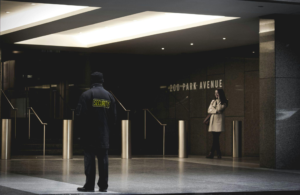
Why Combining Manned Guarding and CCTV Works Better Than Either Alone
Put the facts together, and the conclusion is fairly straightforward: manned guarding and CCTV aren’t competing solutions; they’re complementary layers addressing different parts of the same problem. Cameras provide constant coverage, an evidential record, and a genuine deterrent against planned, opportunistic crime. Officers provide real-time judgement, intervention, and the kind of unpredictable physical presence that’s much harder to plan around.
CCTV schemes deployed alongside other interventions consistently outperform camera-only setups. A guard who can be directed to a specific area the moment something looks wrong on a live feed, rather than reviewing it the next morning, closes the exact gap that undermines cameras used in isolation. Equally, a guard supported by camera coverage across areas they can’t physically watch at once gains eyes on blind spots and can be alerted the second something happens elsewhere on site.
This layered approach matters most in environments carrying real risk: retail premises with high footfall or high-value stock, warehouses and logistics sites with valuable inventory moving through them constantly, construction sites with expensive plant equipment left overnight, and events or venues where crowd behaviour can shift quickly. In each case, the camera and the officer are doing genuinely different jobs, and neither one covers what the other does well.

What This Looks Like in Practice
For a business weighing up its options, the practical version of “both” tends to look like this:
Static or mobile guarding for direct deterrence and response. A visible, licensed officer at entrances, exits, or high-value areas changes the immediate calculation for anyone considering theft or confrontation, and can act the second something happens rather than waiting for a review.
CCTV monitoring to extend coverage beyond what a guard can physically watch. Remote monitoring fills the gaps outside standard hours or across large sites, flags suspicious activity as it develops, and builds the evidential record needed if an incident does escalate.
Mobile patrols for flexible, cost-effective coverage between fixed points. Not every site justifies a permanent guard around the clock; scheduled or deliberately randomised patrol visits across one or more locations offer a middle ground that still disrupts predictable routines.
SIA-licensed door supervisors for access control at higher-risk sites. Venues, retail units trading into the evening, or sites with controlled entry benefit from officers trained specifically in managing who comes in and how confrontations at the door are handled.
Event security for temporary but high-footfall situations. Markets, seasonal sales, and public gatherings bring concentrated crowds and a different risk profile to a normal trading day, and benefit from officers trained in crowd management rather than standard static guarding alone.

A Mistake Businesses Keep Making
One of the most common errors in this whole conversation is treating security as a one-time purchase rather than an ongoing decision. A business installs a camera system, checks the box, and moves on only to find a year or two later that the deterrent effect has quietly faded, exactly as the long-term CCTV research described earlier would predict. Offenders adapt. Coverage gaps that weren’t obvious on day one become well known to anyone who’s cased the site more than once. Footage that was meant to be reviewed regularly ends up sitting untouched until something forces someone to go looking for it.
The same mistake happens in reverse too. A business hires a guard, feels reassured, and assumes the job is done, without ever asking what happens during the hours that guard isn’t on site, or whether there’s a recorded trail if an incident does occur and needs investigating later. Neither approach is wrong on its own. Both just stop short of what a properly layered setup is meant to achieve.
Getting real value out of either manned guarding or CCTV means revisiting the setup periodically, not assuming that whatever was installed or hired at the start will keep working the same way indefinitely.

Getting the Balance Right for Your Business
There’s no universal ratio of guards to cameras that works for every site. A busy city-centre store with high footfall needs a different balance to a warehouse that’s empty overnight, and a one-off event calls for a different setup entirely to a permanent retail unit. What facts consistently point to, though, is that treating either option as sufficient on its own leaves a genuine gap: cameras without response capability, or officers without the extended coverage a monitoring system provides.
The businesses getting the most out of their security spend tend to be the ones asking a more specific question: not “guards or cameras,” but which combination of the two actually matches the risks this particular site faces, at this particular time of year, during these particular hours.

A busy city-centre store with high footfall needs a different balance to a warehouse that’s empty overnight, and a one-off event calls for a different setup entirely to a permanent retail unit. Treating either security option as sufficient on its own leaves a genuine gap: cameras without response capability, or officers without the extended coverage a monitoring system provides.
Closing that gap isn’t about spending more on both; it’s about being deliberate over how the two are layered, so that whatever a camera misses, a person is positioned to catch, and whatever a guard can’t be watching at any given moment, a camera already is.
That’s exactly the thinking behind Adler Security‘s approach to manned guarding and CCTV. Rather than treating the two as separate products, we build each deployment around static and mobile security guard services, remote CCTV monitoring, and scheduled or randomised mobile patrols working together on the same site.
If your current setup is leaning entirely on cameras, or on guards without the coverage a monitoring system provides, contact us today to speak about building a properly layered security plan for your business.